Friday, November 11, 2011

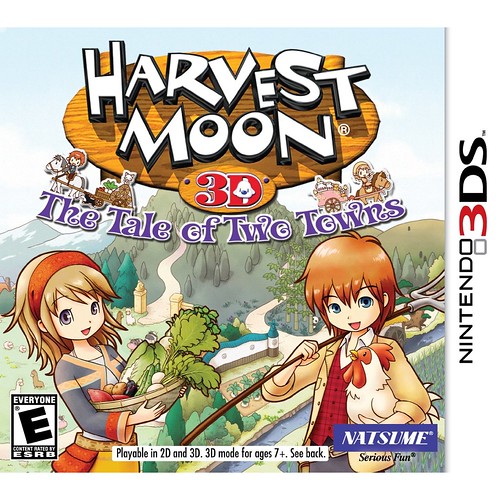
Review: Harvest Moon: Tale of Two Towns (3DS)

Title: Harvest Moon: Tale of Two Towns
System: Nintendo DS, Nintendo 3DS
ESRB Rating: E
Number of Players: 1
Buy It:
Before we start off, let me say this: for all intents and purposes, this review is for the 3DS version of Harvest Moon: A Tale of Two Towns. Other than 3D effects, an animal-petting minigame, and the 3DS region-locking, I know of no differences between the two versions. Now, with that out of the way, let's get to talking about HM:ToTT!

The Harvest Moon games have remained mostly unchanged since the franchise started in 1996 on the SNES. As much a dating simulation as it is a farming simulation, it has a niche following in the United States, making it a small - but successful - franchise. Other than some graphic re-hauling over the years, the main HM franchise has always been about two things: rising up to create a successful farm, and finding yourself a spouse. In that regard, HM: Two Towns does nothing new. But the new things it does bring has kept me interested and occupied.

The most interesting part of Two Towns is that you can choose which town you want to live in at the beginning of the game. The first choice is the farming village Konohana, a tranquil and pretty Japanese-inspired town that centers around raising crops over livestock. On the other side of the mountain, you have your second option: the town of Bluebell, a more European-looking town that centers its income on raising livestock. No matter which town you choose, you can utilize the land on both farms. (This makes it easy to live in Bluebell and raise a lot of livestock and still use the fields in Konohana to raise long-lasting crops like soybeans, corn, tomatoes, etc.) Living in Bluebell is almost like cheating. Living in Konohana is a lot more typical of other Harvest Moon games: being broke all the time and struggling to get the money needed for important things like seeds, fertilizer, and pet food.

Other activities - fishing, bug gathering, and foraging - are back from other games and work just as well as they ever have. Fishing has a new option, though: you can now wade into shallow water and catch fish with your hands by walking up to them and hitting the "A" button. These tiny fish can't be used in cooking, but they can be sold for ten to thirty gold and be used to fulfill requests for villagers.

The 3D graphics add a cute shadow effect to the game, but overall isn't worth the ten dollars extra you have to plunk down for it. The 3DS-exclusive animal petting minigame, however, makes your animals friendlier faster, and is an interesting benefit to getting the enhanced version.

In spite of everything that Two Towns is doing right, though, classic HM bugs are still present. The game freezes periodically and at random times, and when your only option for saving is before you go to bed, a lot of things can be lost. Additionally, the game lags when there's a lot of things going on: riding your horse while other livestock roams around in their pens will cause the game to slow a little bit. In 3D mode, it's motion-sick inducing. In 2D, it's just annoying. The last thing that this game has wrong with it - really, really wrong - is that the weather system only kind of works. Listen to the radio before you go to bed, and it will tell you what the weather for the present day and the next day will be. There's about a 45% chance that the weather forecast for the next day will be wrong, making it confusing and difficult to plan ahead for the next day, especially for weather-specific events like flower events and figuring out what to do with your livestock for the day.

Overall, Harvest Moon: The Tale of Two Towns is fun and addicting. The typical bugs are still present, but are as much a part of the Harvest Moon experience as courting a villager.

Bottom Line: Mostly the same Harvest Moon, but with an interesting addition of choosing where you can specialize. It's a welcome - and interesting - change. Typical HM bugs are still present and more annoying than ever.

Final Score: 8/10

Saturday, November 5, 2011

Topic: Gaming - Pokemon

Gaming is an important part of my lifestyle. What little time I have left between chillaxin' with friends, writing, homework, and life screwing me over, I dedicate to gaming. It's something that was in the house before I got there, and I'll be taking with me to my own household, when I finally decide to strike it out on my own.And one of the franchises that's been in my house since I was a small child was Pokemon. It's a staple in the house, along with Mario, Zelda, Ratchet and Clank, Spyro the Dragon (the original Insomniac games), and Crash Bandicoot (the Naughty Dog games.)

But lately, I've been catching shit for the whole Pokemon thing. No one can give me a reason why, but I'll suspect that it's "Hurrr, you still play Pokemon. You should grow up." But you know what? I loves me some Pokemon games, even now.

Above left: What someone who makes fun of
my Pokemon habit looks like.
There's a mix of reasons for that. One, Pokemon Blue was the first game that was ever truly mine. I didn't have to share it with anyone. I got to play my game, on my GameBoy Color. And the feeling was amazing. Two, I like seeing the games evolve into what they've become today (inb4 sellout.) Three, I still enjoy the hell out of them for what they are - a solid strategy RPG. And four, the spinoffs are fun too.

Now, before you go jumping down my throat about being in my 20s and still playing games designed for children, take a second to stop and think for a second: if you do, you'll look like that guy up there. Do you really want to look like that guy up there? Nah, didn't think so.

The main games in the Pokemon franchise are, whether you like it or not, solid tactical RPGs that're pretty damn customizable. And if you're really into it, it opens a whole new set of doors into the mechanics of the whole thing. Essentially, there's two tiers to everything in a Pokemon game: a casual tier, where you can just play through the story, get your badges, and battle your friends over local wi-fi. And then there's the hardcore tier, where you can specially train your Pokemon for their best stats (IV and EV training,) competitively battle with others, or set special rules that you have to follow throughout the course of your journey. (Go watch a Nuzlocke challenge on YouTube or read the comic on nuzlocke.com to get a better idea of what it is and to see how srs bns Pokemon can get.)

And it's not just the mainstream games that get that treatment, it's spinoffs as well. And everyone knows that when it comes to spinoffs, Pokemon is pretty damn successful. (Just off the top of my head, there's the Pinball franchise, Mystery Dungeon, Ranger, Stadium/Colosseum, PokePark, the upcoming Rumble Blast and more that I know I'm blanking on.) And when Pokemon does a spinoff, they do it right. PMD (Pokemon Mystery Dungeon) is one of the best mystery dungeon games I've ever played. (Keep an eye out for a post on those in the coming couple weeks.) Pokemon Stadium entertained me for literal months when I was a kid, and still does. There's a few horrible games in the franchise, sure, but every franchise has their weak spots.

Any way you slice it, Pokemon's not just for kids anymore. As long as adults can have fun too, Pokemon will continue being everyone's game.

Thursday, November 3, 2011

Announcing a spin-off blog!

So, as we all know, I'm young and insane.

And as you may not know, I've got severe wanderlust.

With one more semester ahead of me before I get my Associate's in Creative Writing, I've been thinking more and more seriously about something I've thought about since I first got my car: a road trip. Not just any road trip, mind you: this would be a road trip for the ages. To go out and see what you've never seen, to do what you've never done, to live like you've never lived.

That's my goal, after I graduate. To go out on an epic road trip and do, see, eat, and experience things I've never done/seen/eaten/experienced before. You can check out the new blog, Smart Across America, and see what my plans are. And when I finally get going on my trip, it'll be everyone's main way to creep on what I'm doing, where I'm going, where I've been, and where I'll be going next.

In the meantime, during pre-trip, feel free to suggest places for me to go/eat/see/do. I'll admit, while I've been doing research myself, sometimes the best things to do are the ones that you learn about from other people. The blog is empty and sad right now, but check back. I'll start putting things up soon!

Tuesday, November 1, 2011

Power Outages and Lacks of Updates

So, you might have heard about the recent snowstorm that pummelled the Northeast. We're out of power here, and that means a lack of updates. I have a few scheduled for the coming days, but unfortunately, until powe is restored, there won't be anything new from here after the last few post. Hang tight, I'll be back soon!

Thursday, October 27, 2011

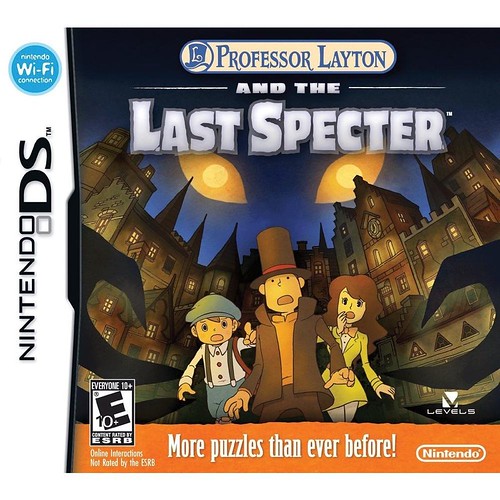
Review: Professor Layton and the Last Specter (DS) PART TWO

Title: Professor Layton and the Last Specter
System: Nintendo DS
ESRB Rating: Everyone 10+
Number of Players: 1
Buy It: Amazon | GameStop | PlayAsia (Japanese) (English)
Other Notes: Soundtrack available on PlayAsia | Read my review of London Life, the mini-RPG bonus game here if you missed it.

If you had asked me what I thought of brain teasers circa 2008, I'd have told you that they were a waste of time. Because they were never something I was ever good at, unlike my father, they were something actively dismissed. Worse, if an assignment called for them for homework in school (and it did, on a few occasions,) I would take an F for the homework grade rather than sit there and suffer through a bunch of puzzles that would infuriate me.

Then Professor Layton walked by, and all that changed. Between the first game's enchanting art style and charming music, I was immediately hooked, puzzles be damned. I was more enchanted by the story, characters, and settings than I was by the puzzles, but they grew on me. Now, at the fourth game in the series, I can say (without sarcasm) that I'm really glad that I took the first step into the puzzle-solving franchise. Professor Layton and the Last Specter takes everything about the series up a notch: story, puzzles, characters, and music, and keeps the entire experience as charming and magical as it was in the first game. But better.

This game (and, yes, the next two,) act as the prequel chapters towards Curious Village and give players an insight to what the gentlemanly Professor Layton was doing before St. Mystere ever became an issue and before Luke started wearing that adorable periwinkle sweater vest he always wears. The game kicks off with a few wonderfully rendered animated scenes and a few easy puzzles to get you going before you start getting kicked in the pants with new, more difficult puzzles. Veterans of the series know what to expect: puzzles ramp up in difficulty the more you play, plot twists come out of nowhere, and hint coins are still hiding in elusive spots. Newcomers to the series won't be disappointed, and the Professor walks through how everything works himself early on so that you don't get confused.

While plot twists and red herrings can still be somewhat frustrating, the story kept me engaged throughout so that I didn't get flustered enough to throw in the towel without seeing things through to the end. Even with the tomfoolery with the plot twists, I can't dock too many points from the game. It's remarkably solid, fun, and still a great way to waste a weekend. If you've been putting off getting the game, stop. Just go get it. If you've been interested in taking the series for a spin and never have, there has never been a better time to join the Professor in solving a mystery.

Bottom Line: Same Professor, but more. More cutscenes, more puzzles, more enchantment. You know, more. And bigger.

Final Score: 9/10

Sunday, October 23, 2011

Review: Professor Layton and the Last Specter (DS) PART ONE - London Life

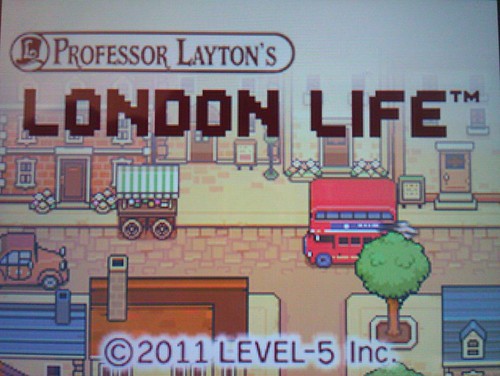
London Life title screen
Title: Professor Layton's London Life (mini-RPG bonus game)
System: Nintendo DS
ESRB Rating: E 10+
Number of Players: 1
Buy It: Amazon | GameStop | Play-Asia.com (English version) (Japanese Version)

I'll say this first: this is a review in two parts. Why? That comes next.

I bought this game the day it came out, and as of right this very second, I have not yet started the main game. That's because of this nifty little bonus RPG that Last Specter came with, called London Life. What is LL? It's one part Animal Crossing, one part Professor Layton, and one part Mother 3 (I think it was called EarthBound in English? Don't quote me on that, though.) And it's one hell of a great time.

You start off by creating a character from the top-down: looks, personality, style, the whole nine yards. Like in Animal Crossing, you start off by getting off a train in a new town and moving into your new apartment. Your furnishings are sparse at first: all you've got is a bed. Over the course of your time in Little London, though, you can buy new things and add to your room, though doing fetch quests for the other Londoners can get you some pretty nifty items that either can't be found anywhere else or are very expensive.

The game operates on two different levels: one is Wealth, the in-game currency. The other is Happiness, which affects almost everything else in the game: what kinds of fish you catch (and how often), what kinds of flowers you find in flower boxes, how much you get paid on jobs, and how well others respond to you. Of course, your happiness goes down if someone in town yells at you, but you can replenish it by making or buying food and eating it. Happiness, in most cases for London Life, is more important than Wealth, but the two are so well intertwined that sometimes it's hard to tell.

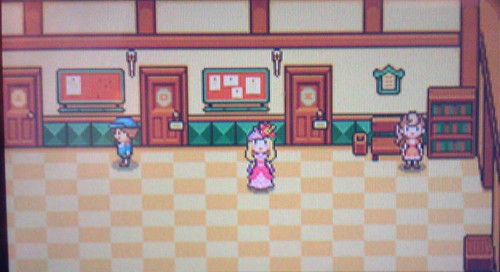
London Life player character (center) seen with
Luke Triton (left) and Flora (right)
But by now you're probably wondering where the Mother/EarthBound part comes in, right? It's all in the graphics, baby. Cute sprites looks like they could've been lifted right out of one franchise and plopped onto the other. It's not a bad thing by a long shot, either: London Life really benefits from sprite usage.

The biggest part about this game though is the part that I fear will turn players off of really playing it: it's all mission based. Don't be turned off by the fact that this is all built on fetch quests. I'm not normally a fan of mission-based games - my dislike of them kept me from really enjoying Kingdom Hearts 358/2 Days - but I literally couldn't put this down. My inner completionist went balls to the walls with this and had a great time learning all the recipes, completing every single mission, and making my million-Wealth apartment all my own.

While the complete mini-story can be completed in around two hours, I had a lot of fun sinking hours upon hours into completing all the quests and helping out all the familiar faces from other Professor Layton titles.

I have no complaints with this game, at all, except maybe that it's too short. In all honesty, I would have bought this as a stand-alone game. It's that good.

Bottom Line: Mini-RPG that comes with Last Specter. Shockingly fun, lots to do, and extremely customizable.

Final Score: London Life gets a solid, well-deserved 10/10

Special Note: You can buy the game's full soundtrack here. It's beautiful, as I'd expect from a Professor Layton game.

Friday, October 21, 2011

Creative Nonfiction is...?

One of the semester long questions that I'm supposed to be finding an answer to is "So, what is creative nonfiction?" And as easy as it would be to just pop onto Google and look up a definition, that's not what my professor is looking for. She's looking for thoughtful, intelligent responses.

It took every ounce of willpower that I had to refrain from putting quotations around most of that last sentence. Not because it's there, but because the terms "thoughtful" and "intelligent" are relative. Especially - let's be real here - at a community college. Okay, now that I'm done making fun of community colleges and the people who attend them (myself included, guys, so chill out,) I can get through with this.

Creative nonfiction, to me, isn't just writing about things that really happened - anyone can do that, and it's called an expository essay or a textbook. No, creative nonfiction employs writing tools and devices from fiction to make a real event or topic interesting, more vivid, or more relatable. It's the "creative" part that keeps it from being dry and insufferable.

So, what does that mean for readers? Well, for one, a creative nonfiction piece should hold the reader's attention, even if the topic isn't one that the reader would usually stick around and pour attention and time into. (See what I'm doing here? If you're still reading this, it means that I'm succeeding.) A journal, blog, or other record that just tells of "I went here and did this and then I went someplace else" isn't going to be very interesting to another person. It probably won't even be that interesting for the person that wrote it.